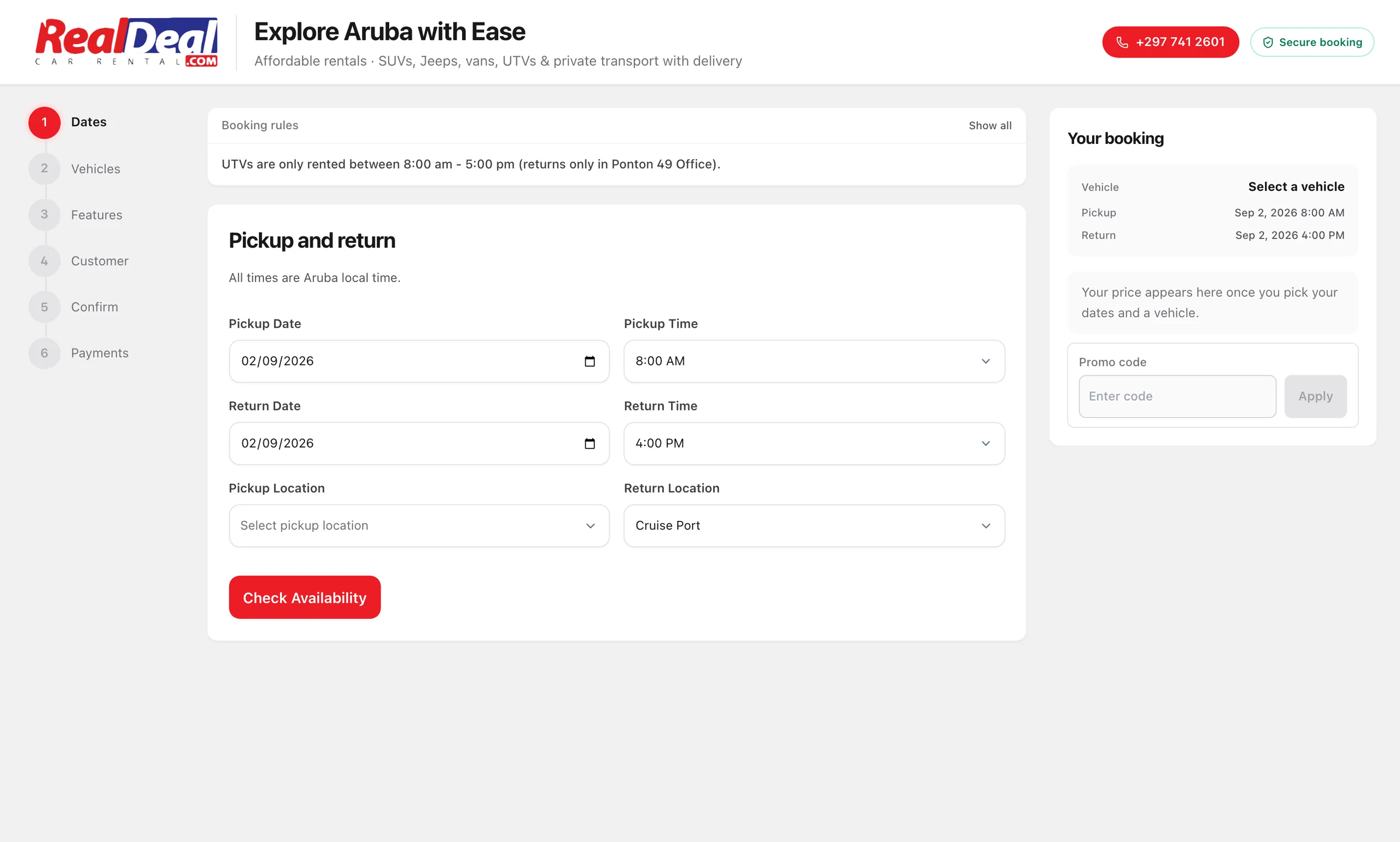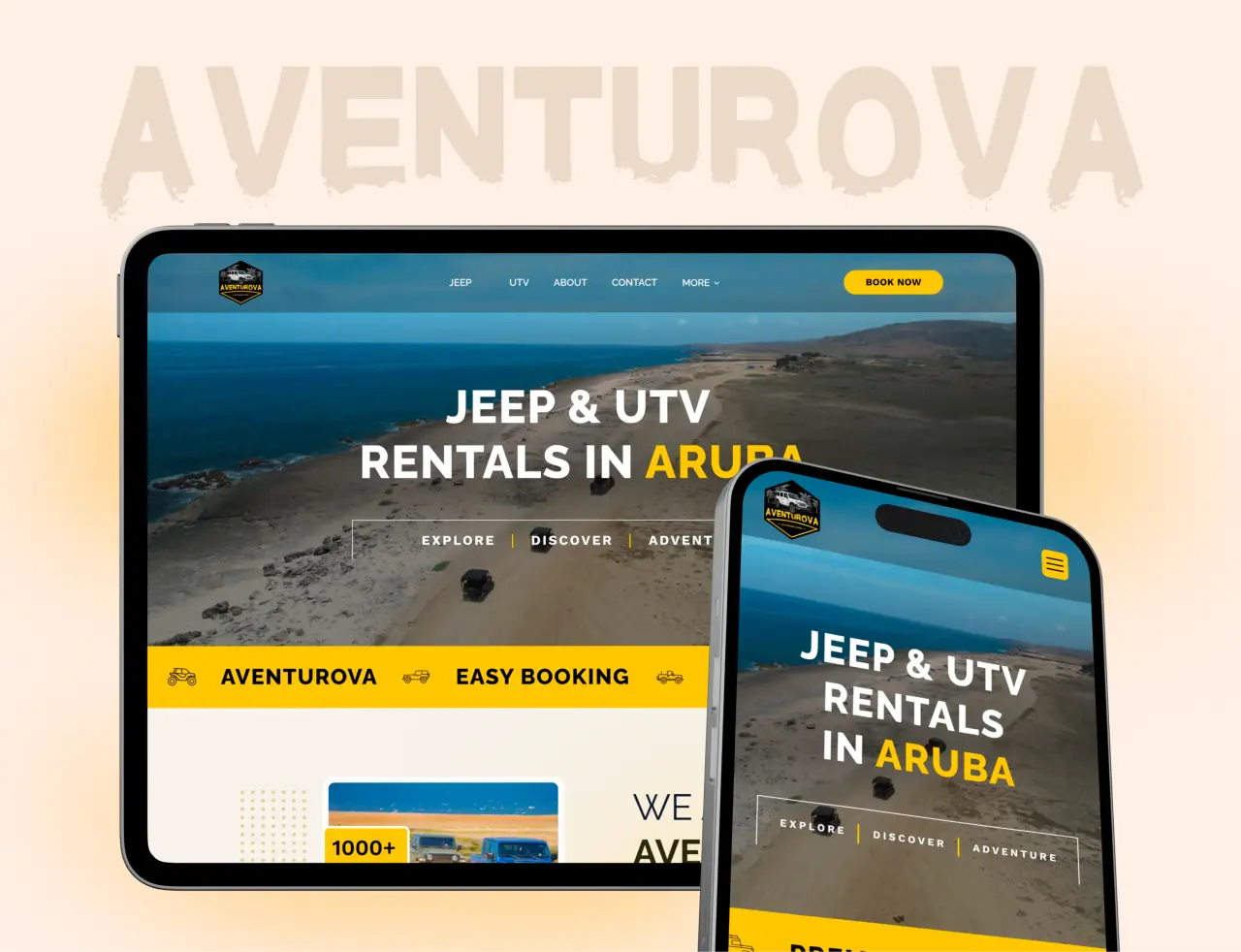





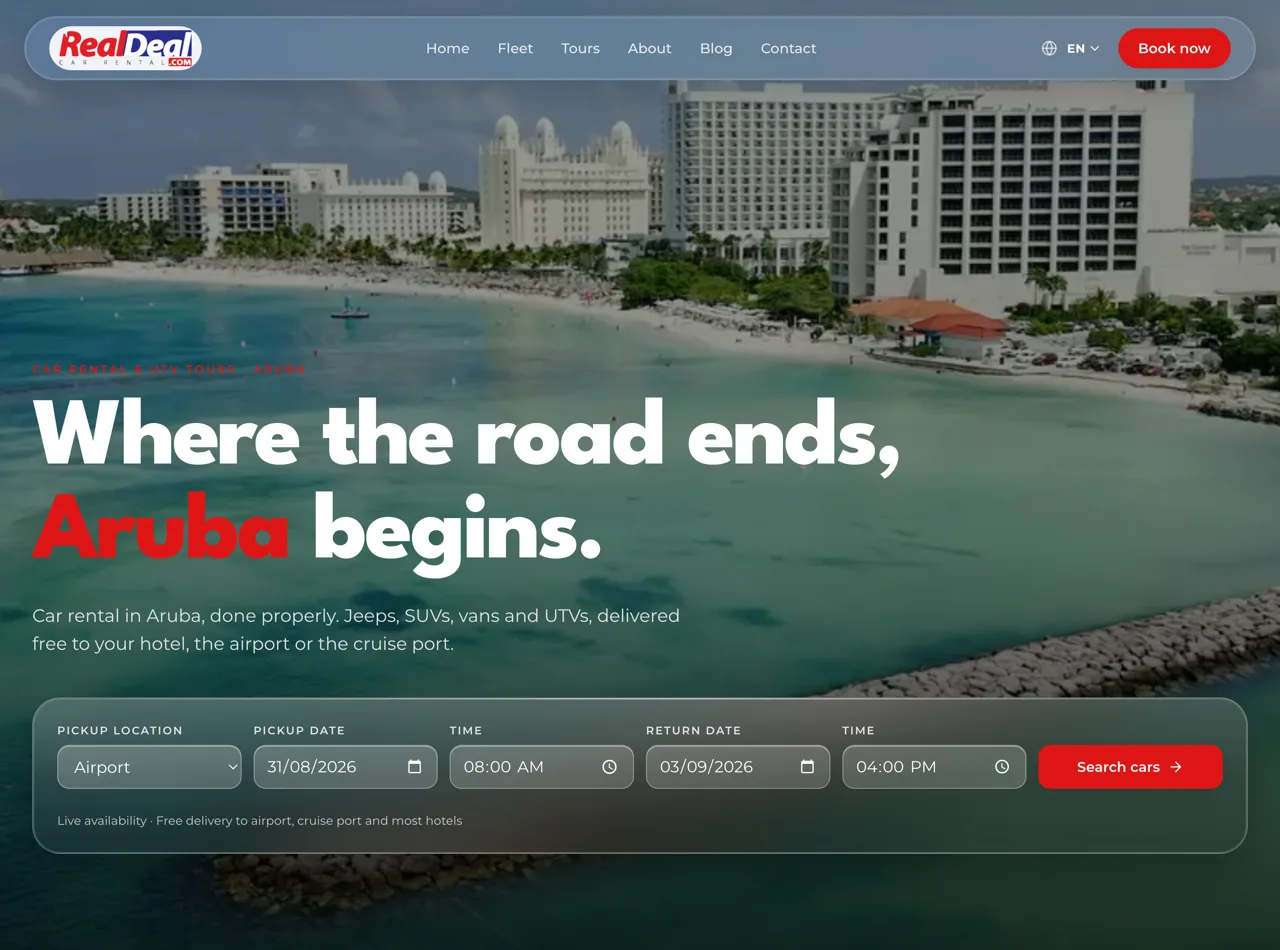
A booking system for a rental or tour company has one job that sounds simple: take a booking at a price the business will honour, for a vehicle or seat that is really free, and hand the day's work to the people at the counter. This guide covers what that takes, how the platforms compare with a system you own, and what we learned building the booking systems behind Real Deal Car Rental, Aventurova and Dushi Transfers in Aruba.
Key takeaways
- A booking system is a pricing engine, an availability calendar, a checkout and a back office. The pricing engine is the part most businesses underestimate.
- Platforms such as FareHarbor, Peek and Bókun are quick to start and charge per booking, per month, or both.
- A custom system costs more on day one and nothing per booking after it. It fits your rules instead of asking you to fit its settings.
- Real Deal runs 16 vehicle models across 8 seasons; Aventurova runs 7 Jeep and UTV models across 7 seasons. Both take bookings online and run the counter from the same system.
- NeoDimensional builds custom booking systems from $6,999, priced in writing before work starts.
What a booking system has to do
Strip away the screens and every rental or tour booking system does four things. It knows what is available on a date and time. It knows what that costs for that guest, on those dates, with those extras. It takes the money, online or at the desk. And it tells staff what is going out and coming back today.
Most problems start when those four are kept in different places: prices in a spreadsheet, availability in a calendar, payments in a card terminal and the day plan on a whiteboard. Each copy drifts. A guest quotes the website against the counter, a vehicle is promised twice, a refund goes to the wrong card. A booking system is worth what it removes from that list.
- Availability per vehicle, seat or slot, including when a busy one comes back
- A price for the exact dates, season, length and extras
- Payment online, by card at the desk, in cash or through a link staff send
- A day board, agreements and reports for the people running the business
The pricing engine is the product
Rental pricing is not a price list. On Real Deal's platform each day of a rental is priced at that day's own season, from a rate card of 8 seasons that recur every year by month and day, and a duration ladder lowers the per-day rate the longer the guest stays. A pickup at 8:00am returning at 4:00pm seven days later is eight rental days, and that rule holds in the quote, the extension, the late-return charge and the invoice.
We build one pricing engine and make every surface ask it: the public booking flow, the staff booking form, the emailed quote, the rental agreement and, on both Aruba platforms, an AI assistant that may quote only totals the engine produced. Real Deal's marketing site goes one step further and only advertises a day rate if it holds for a short trip, a long trip and peak season. Otherwise it asks the visitor for their dates.
This is where platforms and custom systems differ most. A platform gives you its pricing settings. Your own system gives you your pricing rules, written once.
Related: alternatives to FareHarbor.
The counter and the back office
The public booking flow is the part guests see. The part that decides whether staff like the system is the counter at eight in the morning: hand a vehicle over, take payment however the guest wants to pay, print an agreement, and know at a glance what is going out and coming back.
Real Deal's back office has a day board, calendar, fleet and maintenance, contracts, coupons and traffic fines, staff scheduling and work hours, a finance ledger with export, roles and an audit log. Signed rental agreements are generated as PDFs that itemize every extra, so nothing is charged without being named. Payment links staff send by email or WhatsApp expire, close when the booking is cancelled, and cannot be paid twice.
Money paths run in serializable database transactions, so two staff editing one booking cannot overwrite each other's balance. Real Deal's live release passed 2,979 automated tests on 2026-10-07; Aventurova's passed 2,364.
Three ways to get one
Per-booking platforms such as FareHarbor and Peek charge no monthly subscription and take a fee on each online booking, often shown to the guest at checkout. Subscription platforms such as Bókun, and rental platforms such as HQ Rental Software, charge a monthly plan, sometimes with a smaller booking fee on top. A custom system is built once for your business, and after that you pay for hosting and the changes you ask for.
None of these is wrong. A new company with a few hundred bookings a year and simple pricing is usually best served by a platform it can switch on this week. The case for your own system grows with your volume, with how far your rules are from the platform's settings, and with how much you want partners, guest data and the checkout to be yours.
Related: what FareHarbor's booking fee costs over three years.
FareHarbor, Peek, Bókun or your own system
None of these vendors prints one price for everybody. The figures below are ranges reported by public comparisons and software listings in October 2026. Ask each vendor for a current quote for your business before you decide.
| FareHarbor | Peek Pro | Bókun | Your own system | |
|---|---|---|---|---|
| Monthly fee | None reported | None reported | Free plan, then about $49 to $499 | None, hosting only |
| Booking fee | Up to about 6% direct, about 2% via resellers | Reported up to 6% to 8% | Reported about 1% to 1.5% on paid plans | None |
| Card processing | Separate | Separate | Separate | Your Stripe account, at Stripe's rate |
| Upfront cost | None | None | None | From $6,999 |
| Your rules | Platform settings | Platform settings | Platform settings | Built in exactly |
| Who owns it | The vendor | The vendor | The vendor | You |
Car rental, tours and airport transfers
Car rental needs seasons, length-of-stay pricing, protections and add-ons, deposits, pickup points and agreements. Real Deal offers 16 models across 24 units, 12 add-ons and protections, and 5 pickup and return points including the airport and cruise port.
Activities and tours need time slots, capacity and packages. Aventurova's UTVs rent in four- and eight-hour packages, only between 8:00am and 5:00pm, returning to one office, and an unavailable machine shows when it comes back so the guest can move to the afternoon instead of leaving.
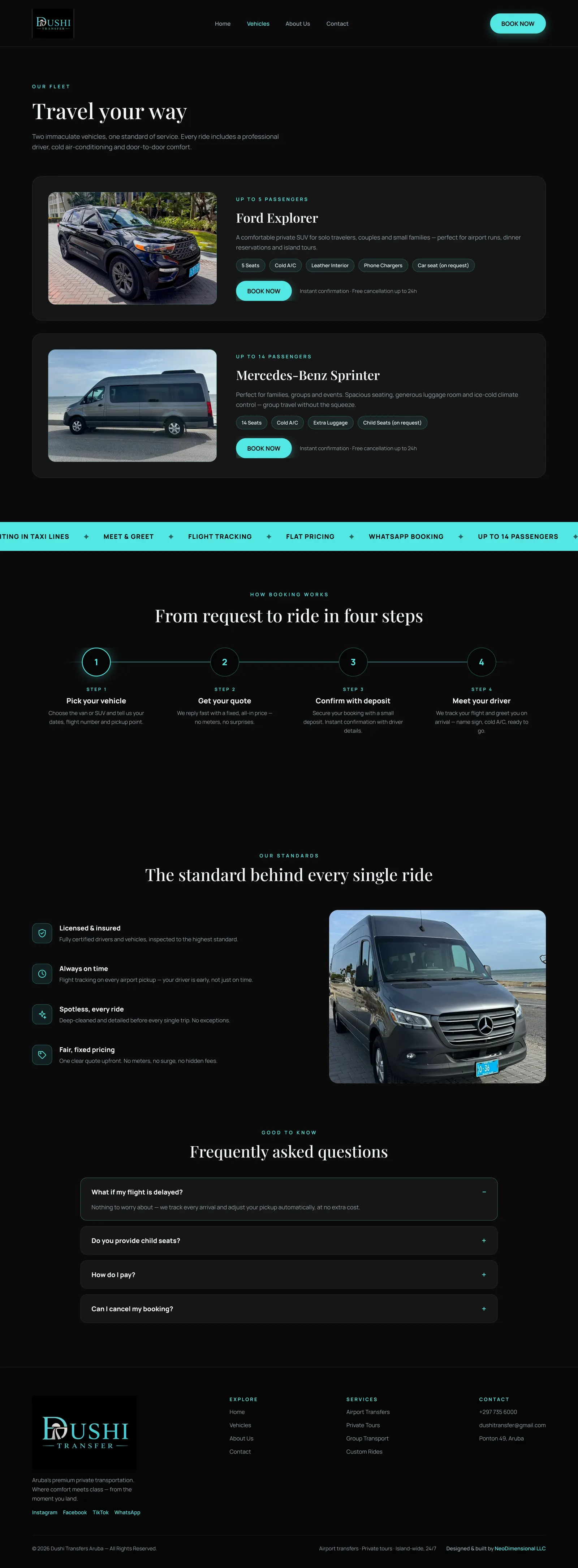
Airport transfers need a route, a vehicle size and a time tied to a flight. Dushi Transfers drives visitors from Queen Beatrix International Airport in vehicles for up to 14 passengers, and its booking system at book.dushitransfer.com is our work, as is the website in front of it.
Related: a Peek Pro alternative.
What a custom booking system costs
NeoDimensional builds custom booking systems from $6,999. A full rental platform with a counter, agreements and a back office costs more than that, and the final price depends on your rules, payments and reporting. It is fixed in writing after a 30-minute call, before work starts.
You pay 30% to start, 40% at review and 30% at launch, to a US company in USD. The code, the hosting and the payment accounts are in your name, and we fix defects for 30 days after launch. If you also need the website in front of it, our website packages are $1,999, $2,999 and $4,499, design and development together.
The rest of this guide
Each page below takes one question further, with the same facts and the same prices.
Related: the Real Deal case study.
- FareHarbor alternative: when to leave and what to replace it with
- FareHarbor fees explained: who pays the booking fee and what it costs over three years
- Peek Pro alternative and Bókun alternative: the same question for the other two platforms
- Car rental booking software: lessons from two live platforms in Aruba
- Tour booking software and airport transfer booking software: what each kind of business needs
- A platform subscription against your own system, with a worked three-year example