




FareHarbor does not charge a monthly subscription, which makes it look free. It earns from a fee on bookings instead, and that fee is easy to miss because it usually lands on the guest's total rather than your invoice. Here is what public comparisons report it charges, who actually pays it, and how to work out what it costs your business over three years.
Key takeaways
- Reported: no monthly fee, up to about 6% on direct online bookings, about 2% on bookings through resellers and the API, and card processing on top.
- The direct booking fee is usually added to the guest's checkout total, so guests pay it, but it still makes your price look higher.
- Extras such as hosted websites and distribution services are reported as separate charges.
- Example: $250,000 a year in direct online sales at 6% is $15,000 a year, $45,000 over three years.
- FareHarbor prices by business. Ask for a current quote and compare it with a fixed build price.
What FareHarbor charges
FareHarbor does not publish one price list for everybody. Public comparisons and software listings in October 2026 report the following. Treat it as a starting point and ask FareHarbor for a current quote for your business.
| Charge | Reported amount | Who usually pays |
|---|---|---|
| Monthly subscription | None | — |
| Direct online booking fee | Up to about 6% | The guest, added at checkout |
| Reseller and API bookings | About 2% | The operator |
| Card processing | Charged separately | The operator |
| Hosted websites, distribution, marketing | Separate, quoted per service | The operator |
Who actually pays the booking fee
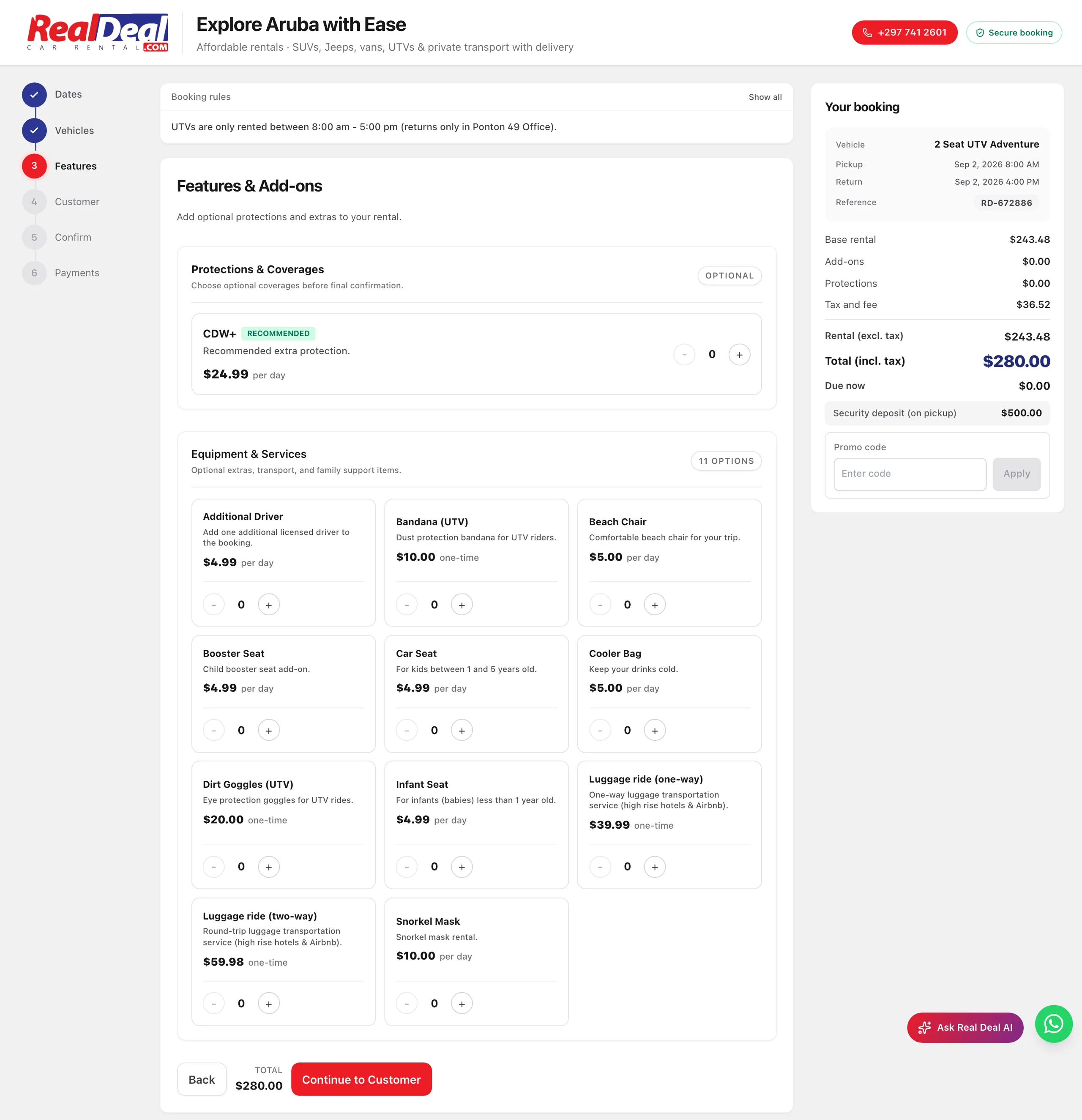
On direct online bookings the fee is usually shown to the guest as a booking or service fee at checkout. On your own books it costs nothing. In the guest's eyes your $100 tour costs $106, and the competitor down the road with its own checkout costs $100.
You can choose to absorb the fee instead, which keeps your price clean but comes off your margin. Either way the fee is real money that leaves the sale. The question is only whose pocket it comes from.
What it costs over three years
These are worked examples at the reported 6% direct rate, not quotes. Put in your own online sales.
| Direct online sales a year | Fee a year at 6% | Over three years |
|---|---|---|
| $50,000 | $3,000 | $9,000 |
| $100,000 | $6,000 | $18,000 |
| $250,000 | $15,000 | $45,000 |
| $500,000 | $30,000 | $90,000 |
Other charges to ask about
Public comparisons mention separate charges for hosted websites, API access, private events, staff modes, distribution and performance marketing. None of these is good or bad in itself. Ask for each one in writing so the quote you compare is the whole cost.
Ask too what happens to your bookings and guest data if you leave, and in what format you get them. That is the cost that never appears on an invoice.
Related: FareHarbor alternatives.
Ways to lower the cost
Sell more through channels with a lower fee, if your resellers allow it. Ask whether your volume qualifies for a different rate. Compare the fee with a subscription platform such as Bókun, which reportedly charges a monthly plan and a smaller booking fee.
Or own the checkout. A booking system built for your business has no fee on each booking: the guest pays your price, through your Stripe account, at Stripe's own processing rate. NeoDimensional builds them from $6,999, fixed in writing after a 30-minute call. At $100,000 a year in direct sales, three years of a 6% fee is $18,000; at that point the build price is worth comparing on money alone.
Related: a platform against your own system, worked over three years.